How to Cross the Argentina–Bolivia Border
I started my South America trip from my beautiful country, Argentina.
La idea inicial era conectar Sudamérica por tierra, pero los inconvenientes socio-políticos de Ecuador y Venezuela en este momento (Sep 24) no lo hicieron posible.
Plans may change, but they are never abandoned. I invite you to join me on this little journey through the Latin American lands.
Starting with Bolivia. If you want to see everything you can explore in Bolivia, check it out here.
Border La Quiaca (Arg) to Villazón (Bolivia)
My dad was going to drive me from Salta to the Villazón bus station and then head back.
If I had known everything I’m about to tell you beforehand, I would have said goodbye to him at the border. Let me explain—there are just too many procedures.
Crossing the Argentina – Bolivia Border by Car
In this article, I’ll guide you through the land border crossing from Argentina to Bolivia. Don’t worry—these procedures are 100% applicable if you’re traveling in the opposite direction, from Bolivia to Argentina.
To cross from La Quiaca (Argentina) to Villazón (Bolivia), there is a small bridge that only allows one vehicle at a time.
So, the first step is to park your vehicle. You can either park somewhere in town and come back for it later, or use the official parking lot (in the image, I’ve included the prices as of September 2024).
4 Border Procedures When Crossing from Argentina to Bolivia
After that, each passenger must get off the vehicle and complete procedures at 4 different checkpoints.
ARGENTINA IMMIGRATION: This is a white trailer with blue inscriptions on the right side of the border area. Here, you must present your passport or ID card, along with the car’s registration document (cédula verde).
They will give you back a document for your car called the “PASAVANTE”. This is one of the most important documents, and you will be asked to show it repeatedly throughout the crossing.
• BOLIVIAN IMMIGRATION: it’s the third trailer on the right, painted blue. There you need to present the same documents (passport or ID, and the car registration).
They will give you a proof of entry into the country, which you need to keep until the day you leave. They do not stamp your passport.
Argentine Customs
It’s the white building on the right (the one closest to the bridge). Here, you present the vehicle owner’s documents and their ID card.
You’ll receive two stamped forms that you must present to Bolivian Customs.
• BOLIVIAN CUSTOMS
It’s the blue trailer on the left (at the same level as Argentinian Customs, directly opposite). There, you need to complete an entry declaration form, which will generate a QR code. Here’s the page to do it.
Once you are attended, you need to show the QR code along with your ID credentials, the vehicle registration, the document given by Argentinian Immigration, and the form provided by Argentinian Customs.
Once you complete ALL of that, you will receive the vehicle crossing permit; this is first checked by Bolivian Customs and then by Argentinian Customs.
In this case, Bolivian Customs is more important, as they control entry into their country.
Crossing the bridge (by car)
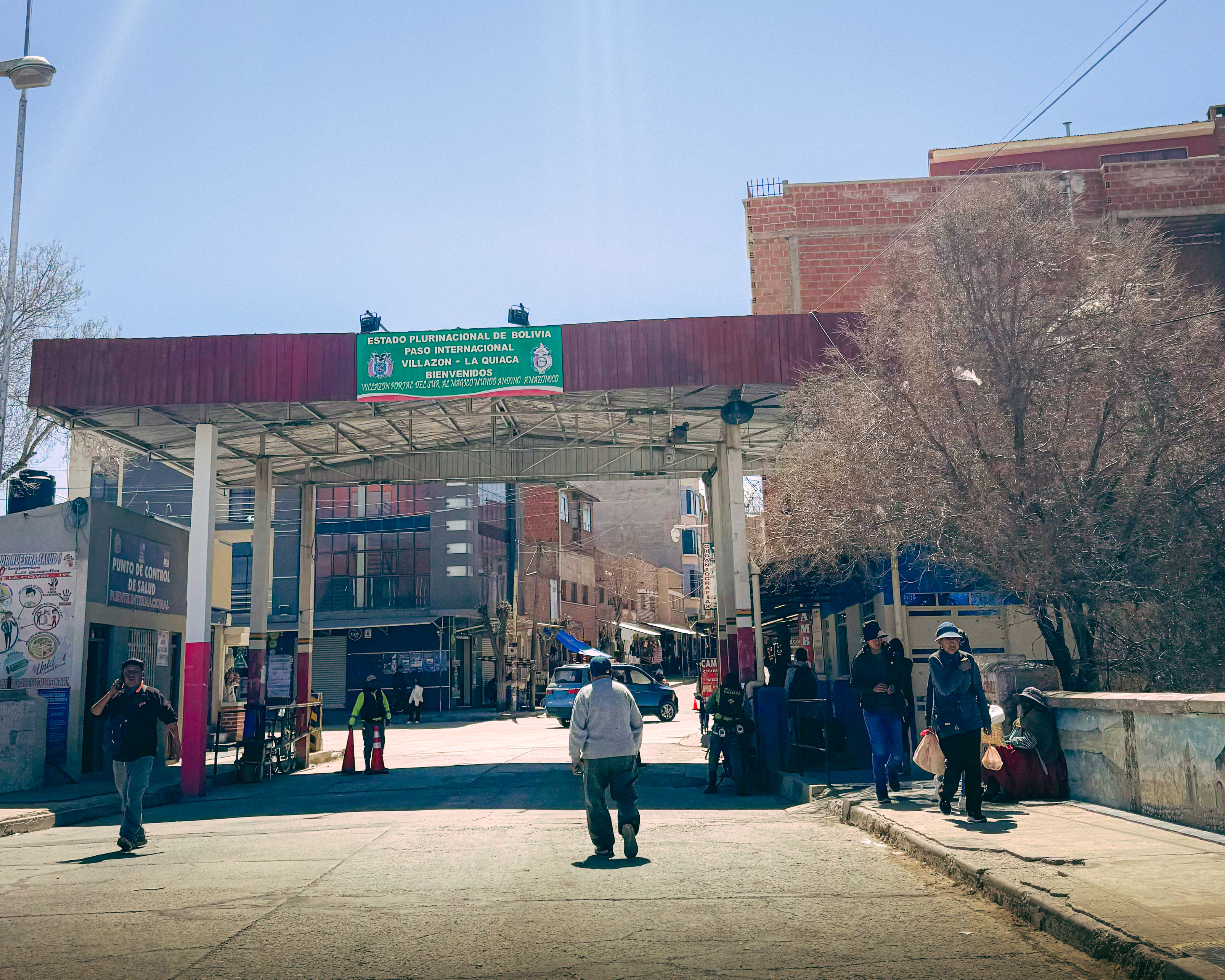
When you think everything is ready, they will stop you just before entering the city of Villazón.
One of the passengers has to go to a Bolivian Health checkpoint and pay 20 Bolivianos (there’s an exchange house right in front, though the rate isn’t the best). This fee is for a “vehicle fumigation.”
Additionally, the traffic officer (who stops you to go to the Health checkpoint) charges 5 Bolivianos, though I didn’t understand the reason why.
These last two procedures also provide payment receipts, which you must present when exiting the country.
After completing all of this, you would finish the procedures and be able to enter Bolivia in your own car.
I think this is convenient if you’re planning a road trip through Villazón and even Uyuni (about 300 km in total). But if that’s not the case, I would never recommend going through this process.
Crossing from Bolivia to Argentina by Car
To do the reverse route, the only thing to consider is that Bolivian immigration is located in a booth before crossing the bridge, and Argentine immigration is on the other side of the same bridge.
In this case, the order of the procedures is:
Bolivian Immigration, Argentine Immigration, Bolivian Customs, and Argentine Customs.
Keep in mind that Argentine authorities will take their time and inspect everything thoroughly, as this is a high-risk area for smuggling.
Crossing the Argentina – Bolivia Border on Foot
This procedure is much easier, and there are even buses you can book from Salta or Jujuy.
Alternatively, there are taxis that drop you off at the border, and others that pick you up on the Bolivian side to take you to your desired destination.
Most likely, you’ll arrive at the Villazón bus station. To get there by taxi costs around 5 Bolivianos, roughly 0.5 USD.
The only difference compared to the car procedure is that customs basically consists of a scanner where you place your belongings.
And you also skip the Bolivian health inspection part.
I know it’s a bit confusing and slightly uncomfortable to handle everything on your own, but it’s really just procedures.
If you have any questions or if something isn’t clear, I’m more than happy to help you out. Remember, I’m always just a message away on Instagram or TikTok at @guadiviajando
Good luck and enjoy exploring Bolivia! See you at the next destination!