Thinking about clicking on the most diverse island with the best skyline in Asia? In this guide, I’ll tell you everything you need to know to visit Hong Kong: from how to get in, what to see, how much it costs, how to get around, and some tips I picked up along the way.
🚨 Just a heads-up: Hong Kong is a Special Administrative Region (SAR) of China, and its political and border situation may change over the years. This article is based on my 2024 trip and updated for 2025, so always check the most up-to-date information before travelling.
Now, grab a pen or open your notepad, because here’s a summary of everything I wish I had known before setting foot in HK!
Entry requirements for Hong Kong
Do I need a visa to enter Hong Kong? Isn’t China one of the more complicated countries? And is the internet blocked? Wait! I was super confused too, which is why I’m going to break it down point by point.
Visa to enter Hong Kong
- Argentina and Latin America: No, we don’t need a visa to enter! Yayyy. We can stay in the country for 90 days without any issues. Just make sure your passport is valid for at least 6 months, and in some cases you may be asked to show a departure ticket (though I wasn’t asked for one).
- EU (including Spain and Italy), UK and Australia: can also enter Hong Kong without a visa for 90 days.
- Estados Unidos: Tampoco necesita visado para visitar HK.
However, never rely solely on information from a blog. Check this official page for the latest updates.
Differences between visiting Hong Kong and travelling to mainland China
One thing that often causes confusion is that Hong Kong and mainland China do not share the same immigration system. This is key when planning your trip:
If you want to cross over to mainland China (Beijing, Shanghai, Shenzhen, etc.), you will indeed need a traditional Chinese visa, which must be arranged before travelling depending on your passport.
💡 Hong Kong to Macau: You can do it without any problem, as it’s also a Special Administrative Region (SAR) and its immigration system is independent from mainland China.
How to get to Hong Kong?
Arriving by plane in Hong Kong
Hong Kong has one of the most important airports in Asia (HKG), with direct flights from numerous cities across Asia, the United States, and some from Europe.
To find the best flight prices, I always use SkyScanner. Since these are often long flights with layovers, sometimes it’s worth looking for separate legs — for example: Rome – Abu Dhabi and then Abu Dhabi – Hong Kong.
Get to HK in ferry or train
You can also connect to Hong Kong by train or bus with major cities like Shenzhen and Guangzhou in mainland China. Keep in mind, though, that for this you’ll probably need different entry requirements and, in fact, a VPN.
Macau is even easier to reach with multiple bus or ferry options, which you can book here.
From the airport to the city center of HK
There are options for every budget, but these two are the main ones:
- Airport Express (fast train): Connects to Hong Kong Central in about 25 minutes. It starts running at 6 a.m. and goes until nearly 1 a.m. Prices range from 105 to 115 HKD (~14 EUR) depending on the stop.
- Buses (budget option): Line A21 connects the airport with Tsim Sha Tsui (Kowloon) and passes by the ferry terminal to Macau. The journey takes approximately 1 hour, and the service starts at 5 am.
To get around using public transport and even to pay in convenience stores like 7-Eleven, you need to know about:
Octopus Card — a must-have in Hong Kong
The Octopus Card is a rechargeable card that you’ll use for almost everything in Hong Kong (transport, supermarkets, vending machines, and some restaurants) — literally like a debit card.
Where to buy it? At many major metro stations, but I recommend buying it at the airport as soon as you arrive (it costs the same). You just need to look for the MTR Customer Service Centre, which has little booths in the middle of the Arrivals area at the airport.
Price and deposit: The card costs 150 HKD (~18 EUR), of which 50 HKD (~6 EUR) is a refundable deposit and 100 HKD is credit to spend. The card can only be purchased with cash (you’ll need to exchange some currency to HKD as soon as you land).
💡 Remember to return the card to get back the deposit and any unused balance.
How is Hong Kong divided?
Before telling you where to stay, I need to explain a bit about how Hong Kong is divided;
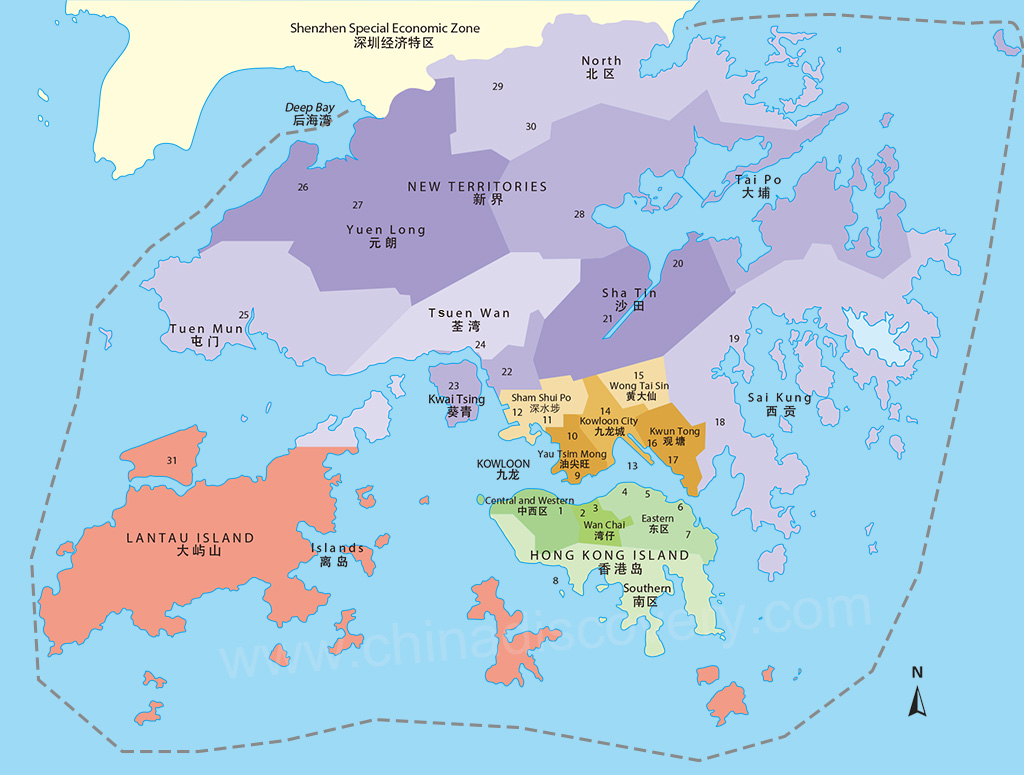
- Hong Kong Island: It’s the most famous part, home to the iconic skyline we all think of. It’s the financial and tourist heart of the city.
- Kowloon: It’s right across from HK Island, on the other side of Victoria Harbour. Key areas include Tsim Sha Tsui and Mong Kok. To me, it felt more “China.”
- New Territories: Se extiende hacia el Norte, casi llegando a la frontera con China continental. Es menos turística tiene templos, senderos de hiking y mucha naturaleza.
- Outlying Islands: Includes Lantau (home to the airport and the Giant Buddha), Lamma (with beaches) and Cheung Chau (famous for the Bun Festival).
Where to stay in Hong Kong?

This topic is a bit controversial for me, as I disagree with what I’ve read in most articles.
We chose the cheapest hostel we could find: Traveller’s Hostel in Tsim Sha Tsui (Kowloon). It cost us 32 EUR per night for a double room. I’m not going to recommend it to you, though, because it now has only about 2-star reviews!
Tsim Sha Tsui is a very popular neighbourhood for tourists: one of the most affordable areas, but also full of hotel chains.
But if I had to give advice to a friend —and that’s exactly how I feel writing this— I’d tell her to stay in the central area of Hong Kong Island. Yes, it’s a bit more expensive, but you save a ton of time on transfers and have all the iconic spots (Victoria Peak, Central, Soho) within easy reach.
💡 If your trip revolves around Hong Kong Disneyland, then the best option is to stay on Lantau Island. It will simplify everything and save you hours of transportation.
Hotels in Hong Kong
- No budget worries: I would choose The Upper House or The Murray, both with spectacular views.
- Mid-range budget: Ying’nFlo, it has good reviews, is nice, and has a great location.
- Budget option: Backpackers Hostel HK in Causeway Bay.
How to move around Hong Kong?
Public Transport in Hong Kong
Getting around Hong Kong is much easier than it looks when you see those maps full of metro and ferry lines. The city is super well connected, and there are options for every budget — from the ultra-fast metro to picturesque ferries or local buses.
You can use:
- Metro: Covers almost the entire city, even reaching the border with Shenzhen, and is super fast. The price depends on the distance, but you can pay between 5–15 HKD.
- Buses y minibuses: Son bastante más lentos y cubren zonas más remotas, podes pagar entre 4 – 10 HKD.
- Metro: Covers almost the entire city, even reaching the border with Shenzhen, and is super fast. The price depends on the distance, but you can pay between 5–15 HKD.
- Ferries: Great for crossing Victoria Harbour, cheaper than the metro at around 3 HKD, and offering the best views of the city. If you want a slightly more elevated experience on the water, you can check out this activity.
💡 To pay, simply tap your Octopus Card on the reader both when you get on and off (so you’re charged for the distance travelled), and that’s it! Enjoy the views.
Taxi and apps for transportation in HK
Uber, DiDi and TADA work perfectly in Hong Kong; of course, they are more expensive than public transport.
What to do in Hong Kong?
What to do in Kowloon?
Kowloon is made up of ultra-famous neighbourhoods like Tsim Sha Tsui, Jordan and Mong Kok. It’s the most chaotic and vibrant part of Hong Kong: people at all hours, neon lights, street markets, and an incredible cultural mix.
Beyond just walking and getting lost in its streets (which is already an amazing plan in itself!), there are some specific attractions I recommend visiting.
1- Avenue of Stars
The most famous waterfront promenade in Hong Kong, from where you can see the skyline of Hong Kong Island.
Honestly, most of the route is usually packed with people and ambient music that can get quite annoying.
But near the ferry station, there’s a small deck with benches and beautiful views, much quieter.
☕️ Foodie tip; at the same ferry station there’s a branch of Mammy Pancake, with their waffles awarded by the Michelin Guide for years. Buying one and eating it in front of the skyline is a pinch me moment.
2- The Peninsula Hong Kong
The city’s most iconic hotel. During the British colonial era it was the place to have tea, and even today it remains a luxury experience.
If your budget doesn’t allow it (like ours 🤣), it’s still worth seeing from the outside as you stroll through Tsim Sha Tsui.
3- Explore Tsim Sha Tsui
The most touristy area of Kowloon: neon signs, shopping centres, shops, hostels… an organised chaos that really represents Hong Kong. One of the most curious stops: Chungking Mansions, a building full of hostels, Indian restaurants, currency exchange offices, and “electronics shops.” It’s chaotic but very authentic.
4- Mong Kok & Lady’s Market
A neighbourhood that is a true live AliExpress: brand knock-offs, the strangest accessories, and all kinds of souvenirs.
It’s also a sneaker paradise: official stores for every brand, often with exclusive models you won’t find in other countries.
☕️ Foodie Tip: Don’t miss the pineapple buns at Kam Wah Café & Cake Shop, a small and unpretentious bakery… but with the best buns in the city.
5- Sik Sik Yuen Wong Tai Sin Temple
One of the most famous temples in Hong Kong, dedicated to Taoism (though also visited by Buddhists and Confucians).
The tradition is to shake some bamboo sticks until one falls: that number is interpreted as your fortune by the diviners at the entrance. Beyond the curiosity, the temple is beautiful and has lovely gardens to stroll around.
Is completly free to visit!
What to do in New Territories in Hong Kong?
There are several spots to explore in the New Territories (mainland area), but I’m going to tell you about the most important ones for tourists that are also well connected to Kowloon by public transport. Perfect for a half-day or full-day getaway.
1- Ten Thousand Buddhas Monastery
A one-of-a-kind monastery in the world with over 10,000 Buddha statues, each one different. The access path is already an experience: you climb and encounter golden figures in curious poses until you reach the main temple. It’s much less touristy than other temples, so you can enjoy it more calmly. See it here.
2- Lion Rock Hike
One of the most iconic treks in Hong Kong, with breathtaking panoramic views over Kowloon and Hong Kong Island. It’s about 7 km in total, and the difficulty is moderate. Watch out for the weather: if there’s fog or rain, a lot of the magic is lost.
How to get there? Take the green metro line to Wong Tai Sin, and from there it’s about a 20-minute uphill walk to the start of the hike.
3- Walled Villages
They are traditional walled villages; some, like Kat Hing Wai or Ping Shan Heritage Trail, preserve the region’s oldest history, with Hakka architecture and small temples.
What you can do in HK Island?
1- Explore the area of Central
From the metro station and IFC shopping centre to the edges of Soho, Central is the modern heart of Hong Kong Island. You’ll find alleys with street art, Instagrammable signs, cafés, bars, and all kinds of restaurants (I even found one selling Argentine empanadas!).
📍Ph spot: Graham Street
☕️ Foodie Tip: Tai Cheong Bakery is especially famous for its egg tarts.
2– Mid-Levels Escalators
The world’s longest outdoor escalator system connects Central with the higher residential neighbourhoods. It’s a city symbol and an essential help to avoid the steep climb. Be careful — it only runs in one direction and changes direction depending on the time of day.
3- Lan Kwai Fong (party)
If you’re looking for nightlife, this is the go-to street for bars and clubs on Hong Kong Island. It’s touristy and a bit expensive, but this is where the night scene really comes alive.
4- The Peak Tram y Sky Terrace 428
The most iconic ascent in Hong Kong. The funicular The Peak Tram gives the feeling of going uphill, and at the top you’ll find the famous Sky Terrace 428 with panoramic city views. There’s also a shopping centre at the top, but the main attraction is the view.
There are tours that combine it with other visits, like this one. However, the standalone prices are:
- Tram + observatory desk: 168 HKD (~20 EUR)
- Train Peak Tram: 76 HKD (~9 EUR) one way and 108 HKD round trip.
5- Man Mo Temple
A small temple but full of history and spirituality, famous for the incense spirals hanging from the ceiling.
It’s free, easy to visit, and very authentic, although it tends to be packed on Sundays.
6- Causeway Bay
The ultimate shopping area: imagine a Hong Kong version of Times Square, with neon signs, giant screens, and crowds. Perfect for a half-day stop if you’re between Central and Quarry Bay.
7- Red Incense Burner Summit
A short walk (15-minute uphill climb via stairs) that rewards you with spectacular views of Hong Kong Bay from a natural viewpoint.
How to get there? You need to take bus 85; the stop is very close to a school. From there, just follow Google Maps — the views are spectacular.
8- Monster building
A group of iconic buildings, photographed endlessly on Instagram. They strongly contrast with the modern skyscrapers: here you can see more clearly the social housing issues in Hong Kong.
If you’re interested in this topic, there are tours about “the dark side of Hong Kong” that go deeper into it, mainly in the Kowloon area.
9- Shek O Beach
Although I didn’t get to visit it, many expatriates who lived in Hong Kong for years recommend it as the best beach on the island. If you have time, escaping to Shek O is a great plan to disconnect from the urban chaos.
What to do in Lantau Island?
1- Tai O, the Fisherman's town in Lantau
My favourite excursion — time takes on a different rhythm, and you can observe the culture surrounding the inhabitants of this small village. The plan is simple: stroll along the piers, see the stilt houses, and let yourself be carried along by the pace of life of those who still make their living from fishing and drying seafood.
You’ll find plenty of food options (try the dried fish snacks — they’re typical) and cute little shops with local crafts.
How to get there? From Tung Chung you can take bus 11; the journey is quite long. From the Big Buddha there are direct buses, so it’s recommended to visit them together.
If public transport or downtime isn’t your thing, there are tours that take you to both attractions.
2- Big Buddha / Tian Tan Buddha
It’s the most famous postcard of Lantau. At 34 meters high, it’s one of the largest bronze Buddhas in the world. To reach the base, you have to climb 268 steps.
It’s located right next to the Po Lin Monastery (an important temple for locals). Entrance is free.
How to get there? From Tung Chung you can take bus 23 or also get there by cable car.
3- Hong Kong Disneyland
I don’t have personal experience here because I only tried the themed trains with little Mickey-shaped windows that take you to the entrance 😅
What I do know is that visiting Disneyland Hong Kong can be an amazing plan in itself, especially if you’re travelling with children or are a Disney fan. It’s smaller than Orlando or Paris, but it has exclusive attractions like the renovated Sleeping Beauty Castle and themed areas inspired by Marvel.
You can read the low-cost experience of Gael, a Filipino traveller, in this article that I loved.
6 tips I wish I had known before travelling to Hong Kong
If you’re planning to travel to Hong Kong, there are certain details that don’t always appear in traditional guides but can save you time, money, and frustration. I’m sharing my experience with practical tips for travelling to Hong Kong that I wish I had known before my trip.
1– The language barrier in Hong Kong
Although Hong Kong is an international destination, most people don’t speak English, especially in local restaurants and mid-to-low price shops. I recommend downloading Google Translate and using the camera to translate menus or signs. It will save you when ordering food.
2- CASH AND THE OCTUPUS CARD IN HONG KONG
Something fundamental you need to know before travelling to Hong Kong: not all local businesses accept credit cards. You’ll need to carry cash or buy an Octopus Card.
A tip for exchanging currency: at Chunky Monster (an area with lots of exchange offices) you can compare prices and get good rates. The best part is that they accept old or marked USD bills, which doesn’t happen in other Asian countries.
3– Eating vegetarian or vegan in Hong Kong
If you’re vegetarian or vegan, eating in Hong Kong can be a challenge. Menus don’t always include meat-free options, and requesting modifications can be tricky due to the language barrier.
A restaurant I recommend is Wang Fu, even recognised in the Michelin Guide. Although it specialises in meat and seafood, it offers very tasty vegetarian dishes: I tried a stir-fry with vegetables, mushrooms, and rice — delicious! See it here.
4- Internet and SIM Card in Hong Kong
To stay connected, the cheapest option is to buy a local SIM card in Hong Kong (note: it doesn’t work in Macau or mainland China). I got a 50 GB one for 38 HKD at a 7-Eleven, and it worked perfectly throughout the trip.
5- GOOGLE MAPS DOESN'T WORK IN HONG KONG
Although Google Maps works in Hong Kong, public transport schedules aren’t always accurate, especially at night. Tip: check the information directly at the stop or ask the locals.
6- TIKTOK IS BLOCKED IN HONG KONG (AT LEAST NOW)
Even if you have a SIM card from another country, you won’t be able to update the app or see new content. If you use TikTok to save travel recommendations, it’s best to note them down before arriving.
🧚🏽 If you want ideas for your trip, you can follow me on TikTok: @guadiviajando
Quizá les sirva visualizar los puntos y ver las distancias desde un punto a otro, es por esto que cree un apartado en mi Maps para compartírselo. Clickeando acá tienes acceso gratuito a él.
Conclusion: travelling to Hong Kong with the right information changes the experience
Travelling to Hong Kong is an incredible mix of modernity and tradition, but it also has its tricks. With these tips, you’ll be able to get around better, save time, avoid surprises, and enjoy the city even more.
For me, it was both a challenging and fascinating destination, and every detail learned along the way made the experience more authentic.
If you want to keep planning trips around Asia, here are the latest articles about Thailand here.
Note: some links in this article are affiliate links. This means that if you book through them, I receive a small commission at no extra cost to you. Thank you for supporting my work and helping me continue creating travel content.
Guadi.