We’re so used to seeing photos of Venice that we sometimes forget the madness this city really is. Here, the streets are canals, the cars are boats, and behind every bridge there are centuries of history, hidden passages, and beauty that seems out of this world… along with a ridiculous number of tourists.
Venice is often associated with luxury and high prices, but in this article I’ll show you how to travel to Venice on a budget without sacrificing your savings or the experience.
When to travel to Venice?
It depends on two things: the weather and the events.
Clearly defined seasons: winters are cold and summers are very hot. Spring and autumn are the best times to visit. Between late autumn and winter, the Acqua Alta appears — the famous high waters that leave several centimetres on the streets. It’s not dangerous, but it’s peculiar (you’ve probably seen photos of tourists in plastic boots).
Events: they affect prices and crowds. The Venice Carnival takes place in February: magical, yes, but expensive and packed. In July, the Festa del Redentore is celebrated, which also draws large crowds.
🧚🏽 La combinación perfecta entre clima y precios, sería abril, mayo, junio, septiembre y octubre.
How many days do you need to travel around Venice?
Ideally, at least 2 full days are needed to walk at a relaxed pace, get lost among the bridges, and visit the essential spots. Of course, it all depends on where you arrive, where you stay (I’ll explain below why this makes a big difference), and what you want to include in your itinerary.
If you plan to visit Murano and Burano, keep in mind that the vaporetto ride takes time and turns the outing into a half-day trip or even longer.
How to get to Venice?
Fly to Venice
From Europe, it’s quite easy to find cheap flights. To compare prices quickly, SkyScanner is ideal because it lets you filter by country, date, and airport.
Marco Polo (VCE) is the main airport and is just 8 km from Venice.
How to get to the city centre? Bus 5 or ATVO for 10 EUR per trip, or the Alilaguna boat, which drops you very close to Piazza San Marco and costs 15 EUR.
La mayoría de vuelos de Ryanair sin embargo, llegan a Treviso (TSF) que está a 40km.
How to get to the city centre? It’s easy and convenient, costing just 12 EUR on the ATVO bus.
Get by train to Venice
Venice is very well connected by train to the main cities in Italy. To quickly compare prices and schedules, Omio works perfectly.
Trains are usually more expensive than buses, but both Trenitalia and Trenord have very useful promotions:
- Passe 3 días: 30 EUR
- Passe 5 días: 50 EUR
They are purchased on the official websites, are personal and non-transferable, and don’t need to be validated.
Oh, this is the perfect opportunity to tell you that I’ve lived and travelled a lot in Italy, and you can find other epic trips here.
⚠️ Importante: si tu ruta hace transbordo en Milán hacia Verona o Brescia, ese tramo lo opera Trenord, no Trenitalia. Si tu pase no cubre ese operador, te pueden multar (me pasó por no saberlo, así que ojo con esto).
How to get to Venice in bus
Travelling to Venice by bus is by far the most economical option. There are several companies connecting the city with destinations within and outside Italy. My favourite metasearch is Busbud, where you can compare schedules and prices (which vary a lot depending on the day and how far in advance you book).
But the best tip is this: always check the website of Itabus, because they often have discount codes and super cheap tickets for travelling around Italy.
Where to sleep in Venice?
Venice is small, but with canals and bridges, distances can be deceptive. That’s why it’s key to choose your area wisely.
-> San Polo and San Marco are the most coveted areas, close to the main attractions and allowing you to enjoy the city early or late without the crowds. They are also the most expensive areas.
-> Dorsoduro, a more affordable neighbourhood located just across the Grand Canal. It has good connections, a young vibe, and is the area with the most bars and clubs that stay open late — perfect if you enjoy nightlife. The hotels are beautiful and reasonably priced (especially if you’re not travelling alone); Hotel Pausania or Cá Beatrice, for example.
-> Mestre, the most popular option among young travellers and backpackers. It’s a city just 8 km from Venice, perfectly connected: there are buses, trains, and trams that take about 10 minutes to reach the island.
I personally stayed at A&o (one of the cheapest options), but I think the Meininger is spectacular. Check availability here.
Another big advantage of Mestre is that many accommodations include free parking, ideal if you’re travelling around Italy by car.
What to do in Venice?
Plans in Venice don’t have to be expensive. Here are several affordable alternatives, with cheap options and some tricks so you don’t miss anything. My recommendation: open the map on your phone and start favouriting all these attractions.
1– St. Mark’s Square
Napoleon called it the most elegant room in Europe, and in person it’s even more impressive than in photos. If you can, visit at sunrise, when the light makes it magical and there are hardly any people.
During the Acqua Alta phenomenon, the square often floods, and you need plastic boots to walk around. It’s part of the Venetian experience, though it can make the visit a bit tricky.
2- Free walking tour
Venice is much more than car-free canals: it’s full of history, powerful figures, and amazing traditions. That’s why a free walking tour is the best way to start your trip and understand the city from a different perspective.
You can book the tour on many websites, but the guides have to pay these platforms 3 EUR per person; it’s better to book directly through their websites. My experience (super positive) was with Itaka Tour.
3- Ducal Palace
If for Napoleon St. Mark’s Square was “the most elegant room in Europe,” much of the credit went to the façade of the Doge’s Palace. For centuries it served as the seat of government and also functioned as a prison (yes, all within the same complex, though separated by many years).
The Sala del Maggior Consiglio is one of the most impressive rooms in the palace and houses a canvas considered one of the largest in the world. It’s definitely worth the visit.
Entrance normally costs 30 EUR, but if you buy online 30 days in advance, you can get them for 25 EUR (this is the page). Another option is to buy in advance here or with a guided tour (highly recommended) and combined with St. Mark’s Basilica and its terrace.
4– St. Mark’s Basilica
St. Mark’s Basilica was built to house the body of St. Mark, which now rests at the main altar. It’s one of the most important Christian temples and also a key artistic masterpiece: mosaics, golden domes, and details that seem out of this world.
On the front, you’ll see St. Mark represented both as a human figure and as a winged lion, his most famous symbol. The book he holds represents that his victories were achieved through wisdom, not violence. Creative, aren’t the artists?
There’s a 4 EUR entrance fee to help with restorations after the flood. There are also guided tours, but if you’re going to invest in one, try to do it combined with the Doge’s Palace to save some money.
Keep in mind that to enter, your knees and shoulders must be covered. Backpacks are not allowed, and photography is prohibited.
5– Views of St. Mark’s Square
Before leaving the square, you might want to see it from above. You have two options:
- The St. Mark’s Campanile, where for 8 EUR you can climb almost 100 meters and see the entire city from above.
- The Torre dell’Orologio, with similar views but for 12 EUR.
Both viewpoints are worth it, but the campanile is usually the preferred option for price and height. Keep reading if you want to visit a free one.
6– Bridge of Sighs
Far from its romantic name, the Bridge of Sighs was the last place from which prisoners sentenced to death saw the sunlight. It connected the Doge’s Palace with the prison, so the sigh wasn’t one of love… but of farewell. The best views are from Ponte della Paglia, although it’s usually crowded.
7- Café Florian
It’s the oldest and one of the most beautiful cafés in Venice. It opened in 1700 and has been serving coffee, snacks, and drinks right in St. Mark’s Square ever since. It’s easy to recognize… and also easy to pay for: an espresso costs around 7 EUR.
⚠️ The menu price isn’t the final cost. If you sit at their tables, they charge a fairly high supplement for service and live music.


8- Grand Canal (pro version)
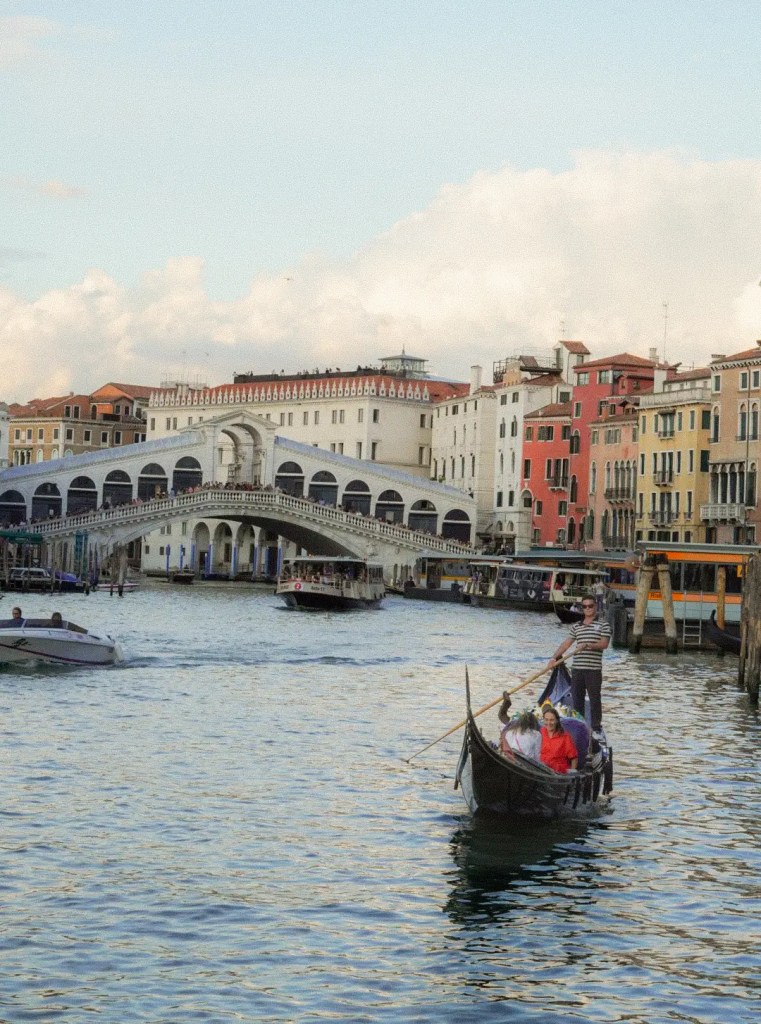
The Grand Canal is about 4 km long and divides Venice in two. It’s impossible not to cross it, and the famous Rialto Bridge spans it. One of the most beautiful experiences is to sail along it, with options for every budget:
-> Water Taxi: Yes, everything in Venice is by water (even the police and ambulances). It’s not as romantic as a gondola, but it can be practical. Prices usually range from 40 to 70 EUR depending on the distance. Always ask and agree on the price before getting in.
-> Taxi Acuático: Sí, todo en Venecia es por agua (hasta la policía y las ambulancias). No es tan romántico como la góndola, pero puede ser práctico. Los precios suelen ir de 40 a 70 EUR según la distancia. Siempre preguntá y acordá el precio antes de subirte.
-> Vaporetto: It’s the equivalent of a bus in Venice, with fixed lines and schedules. The full ride along the Grand Canal takes about 45 minutes, and in a similar time you can go to Burano. A single ticket costs 9 EUR, lasts 95 minutes, and allows you to combine lines. Further down, I’ll give you some tips on public transport.
9– Crossing the Grand Canal on Traghettos
At certain points along the Grand Canal (which you can easily locate on Google Maps), there are traghetti: gondolas used solely to cross from one side to the other, not for sightseeing.
The ride lasts about 2 minutes, but it’s enough to experience it and take a photo. The best part is the price: only 2 EUR, an ideal option if you’re on a tight budget and don’t want to miss the feeling of getting on a gondola.
10– See Squero di San Trovaso (gondola workshop)
It’s the most famous shipyard in Venice and where many of the city’s gondolas are repaired. If you’re curious to see how they restore them or how the craftsmen work, you can visit: they usually organise guided tours and, if available, will let you know on the spot.
It’s better to go in the morning when they’re working.
11- Bridge and Rialto's Market
The Rialto Bridge was the first structure built to cross the Grand Canal. Today it’s full of shops (especially jewellery stores) and tourists. In the waterfront area around it, you’ll find plenty of restaurants and cafés.
Crossing the bridge to the San Polo side, you’ll find the Rialto Market, active since 1250. It’s open from Tuesday to Sunday and has everything: fruits, vegetables, fish, leather, and souvenirs. It’s a perfect place to see the more everyday side of Venice.

12– Observation deck of the T Fondaco shopping centre
The T Fondaco shopping centre offers one of the best views of Venice and is completely free. To go up, you need to book a time slot in advance, which makes the experience much calmer and crowd-free.
Perfect for sunset photos in Venice.
13– La Fenice Opera House
It’s one of the most prestigious and important theatres in the world. Iconic works such as Verdi’s La Traviata premiered here. Throughout its history, it survived two fires and, after its major 19th-century renovation, today it can be visited both inside and by attending a performance.
Performances have specific rules and a dress code, which is worth checking before you go. On the official website you can find all the updated information.
14- Basílica de Santa Maria della Salute
It’s one of the most recognisable structures on the Venice skyline. It’s located on the banks of the Grand Canal and houses works by Titian and Tintoretto. It was built to celebrate the end of the 1631 plague and is closely linked to the Festa del Redentore.
Entrance is free and the views from the area are incredible, both during the day and at sunset.
15- Gelato de Suso
Hey, you can’t be in Italy and miss the chance to eat a good gelato. Suso is a delicious artisanal ice cream shop and very popular in Venice. Prices are a bit higher than average, but they’re 100% worth it.
They offer regular flavours and gourmet options (with a small extra charge), and have two branches in the city. My ideal plan: buy one and enjoy it leisurely on a little balcony with a view of the canals.
16- Ponte dell’Accademia
It was originally built as a temporary wooden bridge, but has remained permanent since 1933. It crosses the Grand Canal and connects to the Dorsoduro district, Venice’s university area, and the Gallerie dell’Accademia, one of the most important Venetian art galleries.
17– Via Varisco, the narrowest street in the world
With only 53 cm in width, Via Varisco holds the record for being one of the narrowest streets in the world. It’s not a must-see, but it’s a fun curiosity to add to your tour and say, “I was there.”
18- Contarini Palace
It was the only palace that didn’t face the canals, so they decided to compensate with architecture. That’s where its famous spiral staircases come from, unique even today. Secret royal meetings were held in this palace, which adds even more mystery to the place.
Today it can be visited and offers spectacular views of Venice, as well as an interesting journey through history. The entrance fee is 9 EUR.
19- Chiesa di San Giorgio Maggiore
Built in 1576 in white marble, this church houses important works of art and has one of the most beautiful viewpoints in Venice. The climb costs 6 EUR and is done by elevator, ideal if you want a great view without climbing stairs.
20- Acqua Alta Bookshop
Famed as “the most beautiful bookstore in the world,” Acqua Alta is one of the quirkiest places in Venice. Among kittens, dreamy postcards, and gondolas full of books, its interior alone is worth the visit.
Even so, the most famous feature is the staircase made of books, from where you can peek at a small, picturesque canal, and the gondola parked there, waiting for the free photo.
20 + 1: Burano & Murano
Just about 45 minutes by vaporetto from Venice, Burano is known as the most colourful island in Italy. Beyond its brightly painted houses, it’s famous for its lace-making tradition, which you can see both in souvenir shops and in its museum.
Murano, on the other hand, is the kingdom of glass. There, you can visit workshops where they demonstrate the craft and museums that tell the history of this trade so closely tied to the island.
Tips for Venice


These are personal tips and questions I wish I had clarified before arriving in Venice.
“Entrance” cost to Venice
On certain dates (holidays and public holidays) when visitor traffic in Venice is very high, a 5 EUR “day pass” is charged to visitors staying in other municipalities, such as Mestre.
Curious details about the city
Many elements of Venice are linked to the Black Plague: candles, virgins, and even gondolas painted black are part of that historical tribute that still remains today. I’m not sure why, but I find it very curious.
What to eat cheaply in Venice
1– The “Venetian aperitivo” is called cicchetti: small skewers that cost around 1.80 EUR and are perfect for eating well on a budget.
2– There’s a bakery called Majer, offering many sweet and savory options, in a good location and with reasonable prices.
Transport and worth it passes
If you plan to visit Murano and Burano, it’s worth buying the 24-hour vaporetto pass. A single round-trip ticket costs around 19 EUR, while the daily pass is about 24 EUR and also includes the ride along the Grand Canal.
Discounts for young people
If you’re under 29, I recommend reading the terms and conditions of the Rolling Venice programme, which offers amazing discounts.
Do you have more time in Italy?
Close to Venice is Verona, one of my favourite cities in Italy. I 100% recommend visiting it; here’s an article about it. Also, it’s near Europe’s most top and Instagrammable church: Madonna della Corona.
Thanks for reading this far, and I hope you really enjoy Venice! If you want to follow my journey (and the others I’m doing), you can follow me @guadiviajando on Instagram and TikTok.
Thanks for supporting my life project and helping me keep travelling.
Guadi.