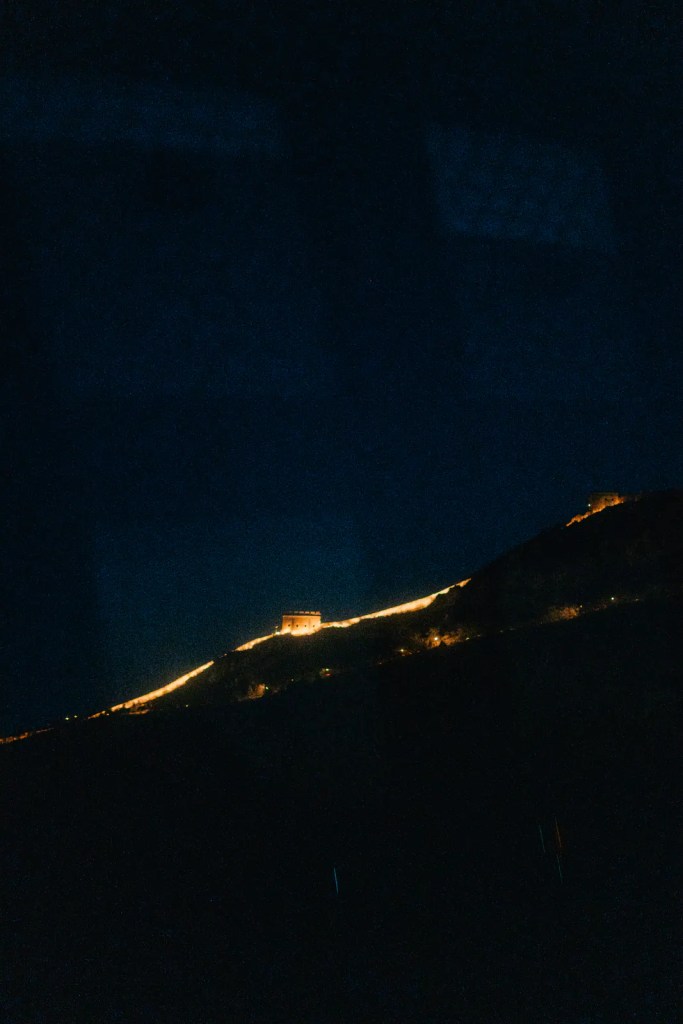
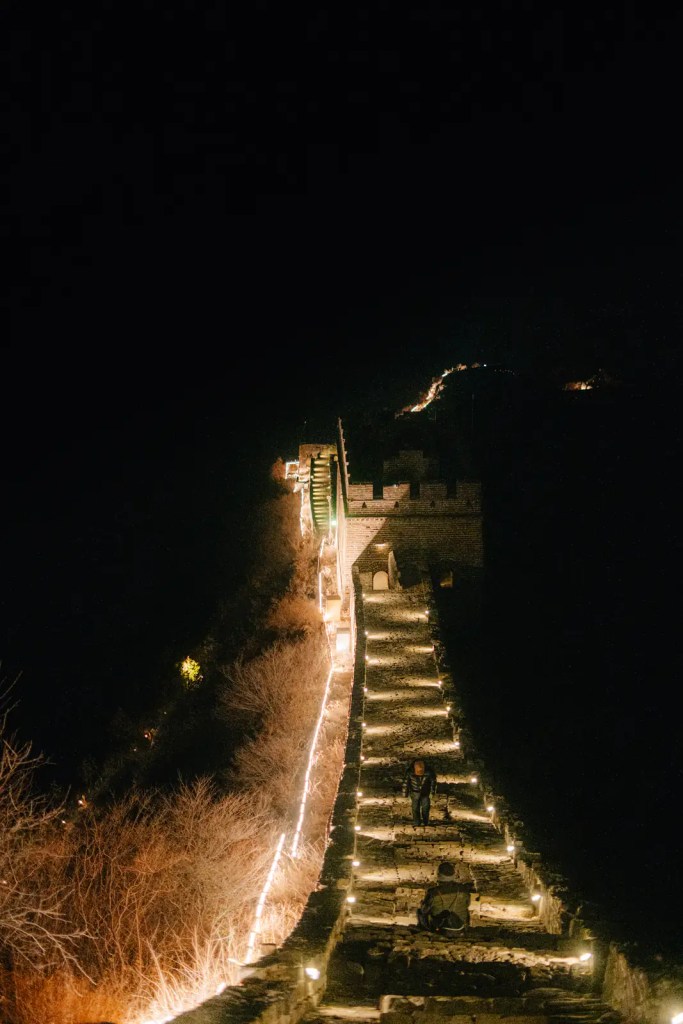
Visiting the Great Wall of China at night, in the Simatai section, was one of the most special experiences I had in China. Before doing some research, I had no idea there was a section illuminated after dark. Seeing the towers and the Wall lit up, with hardly anyone around, was spectacular.
Gubei Water Town is another highlight. This charming tourist town sits right at the foot of the Great Wall and has plenty of lovely corners to explore.
This area is much farther from Beijing than other popular sections, such as Mutianyu or Badaling, so it’s worth planning your transport and timings carefully. I decided to spend the night in Gubei to enjoy the area without rushing and continue exploring other sections of the Wall the following day.
In this guide, I’ll explain how to visit Simatai at night independently, how to get to Gubei Water Town from Beijing, how much tickets cost, and whether it’s worth staying overnight. Shall we?
Is Visiting the Great Wall of China at Night in Simatai Worth It?
Yes! In my opinion, it’s absolutely worth it. It’s an easy and unusual excursion compared with the typical daytime Great Wall trip from Beijing. Seeing the Wall illuminated, with the mountains surrounding it and the town lights below, makes the experience feel quite special.
That said, I wouldn’t choose the night visit instead of seeing the Great Wall during the day. I’d treat them as two complementary experiences because they’re completely different.
I visited at the end of November, when there were very few people around. I loved the contrast between the illuminated Wall and the reddish colours still lingering in the sky at sunset. If I could do it again, I’d arrive early enough to watch the landscape change as the sun went down and then enjoy the first stars appearing.
Is Gubei Water Town Worth Visiting?
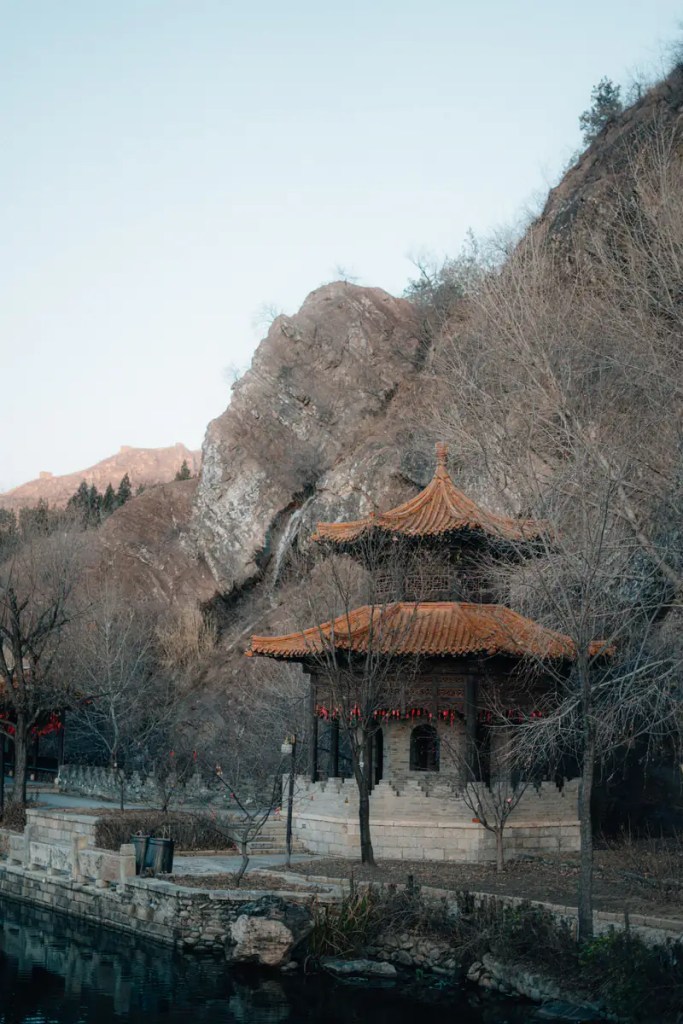
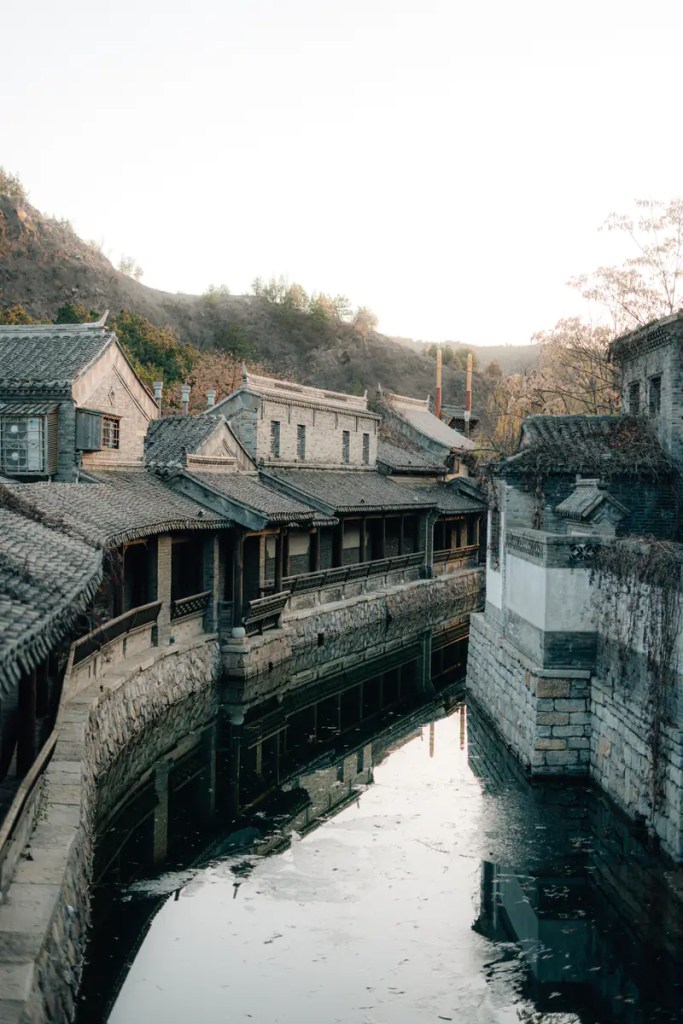
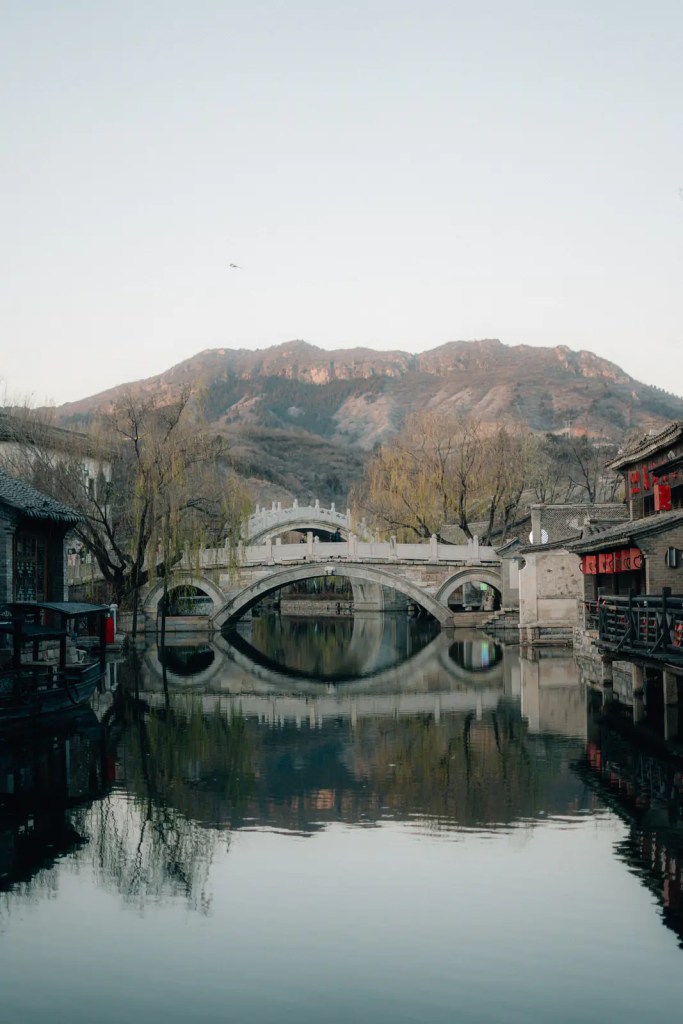
Gubei Water Town is a tourist complex designed to recreate the traditional architecture of northern China, with cobbled streets, canals, bridges, courtyards, restaurants and small cultural spaces.
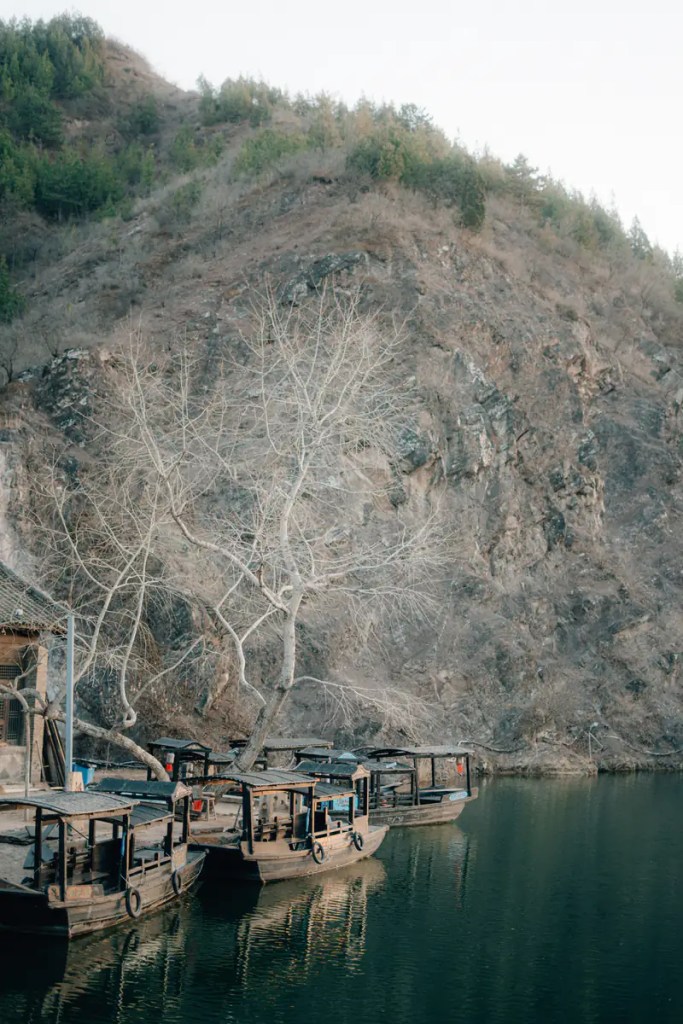
I’m not usually a fan of places created purely for tourism, buuut in this case, the little town sits beside the Yuanyang Reservoir and right at the foot of the Simatai section of the Great Wall. That gives it a huge added bonus!
Combined with a visit to the Great Wall at night, I’d give it a 10/10. If it were somewhere else and the town were the only attraction, I probably wouldn’t dedicate half a day to it. But its location makes the whole experience much more special.
If you have time, I’d combine this experience with another section of the Wall. The following day, I hiked from Jinshanling to Gubeikou, and I loved seeing two completely different sides of the Great Wall. You can read my full experience and practical tips in my guide to the Jinshanling to Gubeikou Great Wall hike.
⏱️ Short on time?
💁🏽♀️ The easiest option
Book a private tour if you want to visit from Beijing and return the same day.🚍 How to get there independently
Take the direct bus from Dongzhimen for 48 CNY (approximately €6.50).
🎟️ Tickets for Gubei and Simatai
The combined ticket for Gubei Water Town and the night visit to Simatai, including the cable car, was listed at approximately €27.
Check ticket options →🏩 Where to stay in Gubei
Yanmen Inn is my favourite option for its location near the Simatai cable car and its value for money.
Check Yanmen Inn prices and availability →How to Get to Gubei Water Town from Beijing
How to Get to Gubei Water Town Independently
💡 You can check the transport options directly in Amap, one of the most useful map apps for getting around China. Just keep in mind that the town may appear as Beijing W Town, rather than Gubei Water Town.
The easiest option is to take the direct bus from the Dongzhimen area to Gubei Water Town. Bus number 22 has only two departures a day, at 8 am and 1 pm. The journey covers around 150 km and costs 48 CNY, approximately €6.50 at the exchange rate used in this guide.
This was the only bus I took in China that didn’t accept Alipay or WeChat payments. You need to pay in cash, so make sure you have some Chinese yuan with you.
The last stop is the car park next to the Lawson convenience store, right by the entrance to the non-ticketed area of Gubei Water Town.
If you have more time and want to spend less, you can combine the 980 Express bus with local bus Mi 51. This option costs roughly half as much, but takes about twice as long.
💁🏽♀️ One more thing: while I was waiting for bus 22, a man approached me offering a shared taxi for 80–100 CNY (approximately €10.70–€13).
Visiting Gubei Water Town on a Tour
It’s also common to visit Gubei Water Town and Simatai on an organised tour from Beijing, returning to the city late at night.
The most important thing is to book a tour that includes the night visit, so you can actually see the illuminated Great Wall.
You can check organised tour options here, or book a private tour for more flexibility.
What to Do in Gubei Water Town?
Gubei Water Town is a tourist complex, so don’t expect to find a historic village that has remained untouched for centuries. Even so, I found it a lovely place to spend a few hours and combine with Simatai.
It’s so pretty! It’s full of photogenic corners, surrounded by canals and little alleyways where you can get lost. There are plenty of restaurants and cafés in inner courtyards or right by the water. You’ll also find temples, exhibitions that change depending on the season, and a viewpoint.
🧚🏽 You don’t need to plan every minute. I’d set aside a few hours to wander around and then organise your visit to Simatai according to the night-entry time.
Gubei Water Town and Simatai Tickets and Prices
Adult admission to Gubei Water Town costs €16–18. The combined ticket for the Water Town, night admission to Simatai and the return cable cars costs €35.
If you decide to visit Simatai in the morning only, you can get a ticket for €5.30 (40 CNY), and you can easily go up without taking the cable car.
You don’t need to buy your ticket in advance, but Trip.com has the same prices and lets you see the ticket combinations and what’s included in more detail.
⚠️ If you’d like to explore more sections of the Great Wall, this article has everything you need to choose the right sections, plus a few extra tips.
How to Visit the Great Wall of China at Night in Simatai
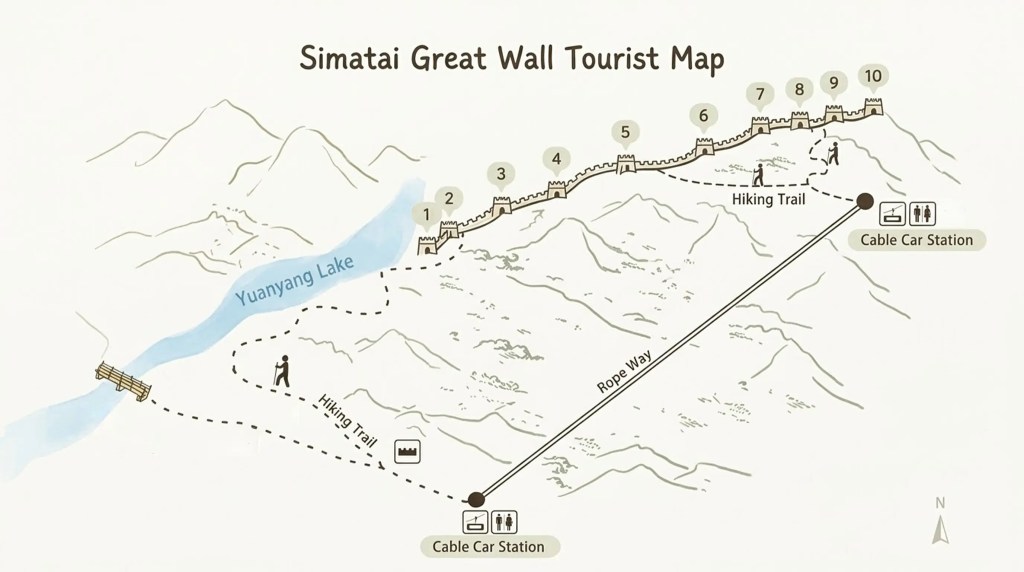
Visiting Simatai at night is different from exploring the Great Wall during the day. You can’t walk freely through every section: access for the night visit is limited, and taking the cable car both ways is mandatory.
You don’t have to visit Gubei Water Town to see the Great Wall at Simatai, although I’d recommend combining both places if you have time.
The ticket for Simatai, the only section of the Great Wall of China illuminated at night, includes a small shuttle bus connecting the beginning of the water town with the cable car area. The journey is approximately 1 km.
During the day, you can walk up to the Wall and explore around 10 towers, covering roughly 2 km. For safety reasons, the night visit requires you to take the cable car up and down, and access is limited to four towers, from Tower 5 to Tower 8.

What Is the Best Time to Visit Simatai?
My recommendation is to arrive right when the night session begins: at 6:30 pm in summer and 5:30 pm in winter. That way, you’ll have the chance to watch the sunset from the Wall. In winter, the sun sets earlier, so if seeing the sunset is reaaally important to you, you should go in summer.
I thought that buying tickets for both the daytime and night sessions would let me enjoy the Wall during the day and watch the sunset. However, during the changeover between sessions, everyone has to leave the Wall. If you want to do both visits, you’ll have to go down and come back up at the relevant time.
💁🏽♀️ I didn’t visit the Wall during the day at Simatai. I stayed overnight in Gubei Water Town, which is close to Jinshanling, where I planned to hike the following day. You can read my Great Wall hiking guide here.
Is This Guide Helping You?
If you’d like to support the blog and help me keep creating free travel guides, you can buy me a coffee!
Ice Latte for your fav blogger ☕My Experience Visiting the Great Wall of China at Night
I decided to stay overnight in Gubei. After checking in, I went to explore the ticketed part of the town at around 4 pm. I wandered around without a plan, got lost in its alleyways and by 6 pm I was already at the cable car entrance, ready to go up to the Wall. It was November and, unfortunately, there was a lot of fog.
You can ride the cable car on your own or with your group. In other words, if you’re travelling as a couple, they won’t put two strangers in the same cabin with you. The journey takes just 8 minutes, but it’s really beautiful and lets you enjoy the landscape from above.
Once you reach the top, there are two paths to explore the Wall. The one on the left is flatter and takes you to Tower 5 without much climbing, although you’ll then have to climb the Wall itself to reach Tower 8.
The other path, closer to the cable car exit, starts with stairs and climbs directly towards Tower 8. From there, you can walk downhill along the Wall towards Tower 5.
Keep in mind that this section of the Great Wall of China is quite steep, and in some places there’s only a wall on one side. I felt a little dizzy at times, so I preferred to climb up along the Wall rather than do the route in the opposite direction.
In my opinion, the best photo opportunity is at Tower 5, looking towards Tower 4. You can see the illuminated Wall stretching into the distance, with no one walking through the frame.


Where to Stay in Gubei Water Town?
To give you an idea, the famous Gubei Water Town is a recreated village surrounded by walls, and you need to pay an admission fee to enter. Most of the hotels, restaurants and cafés in the area are located inside.
Among the accommodation options within the walls, my favourite is Yanmen Inn, thanks to its good value for money and its location very close to the cable car up to Simatai Great Wall. If you’re looking for something more luxurious, William Edgar Hotel has a swimming pool, spacious rooms and a spa.
There are also places to stay outside the walls. The area is pretty, although it’s less geared towards tourism and has less atmosphere than the town itself. I stayed about 100 metres from the entrance, in a small hotel called 37 Degrees Water Town, but I can no longer find it listed! As an alternative in this area, Wtown Inn is my favourite option.
Frequently Asked Questions About the Great Wall of China at Night and Gubei Water Town
Can you visit the Great Wall of China at night independently?
Yes, you can organise the visit on your own. The only things you need to plan are how to get there and how to return to Beijing, and now you have all the information you need to do that!
How much time do you need to visit Gubei Water Town and Simatai?
I’d take the 1 pm bus from Beijing to reach Gubei Water Town in the afternoon, explore the town at a relaxed pace and then go up to Simatai to see the Great Wall at night.
The night visit to the Wall is fairly short. Allow between one and two hours in total, depending on how long you want to spend enjoying the views and taking photos.
Is it better to visit Simatai during the day or at night?
It depends on what you’re looking for. The night visit is special because of the illumination and atmosphere, but the accessible route is more limited. If you want to walk along the Wall and explore other sections, organise a separate daytime visit. I highly recommend Jinshanling; you can read my full experience here.
Shall We Keep Exploring China?
If you’re still unsure whether to visit Simatai, I recommend reading my complete guide to the Great Wall of China, where I compare different sections and explain how to choose the one that best fits your itinerary.
To organise your base in the capital, you can also check out my guide to where to stay in Beijing.
After Beijing, I met up with my family to explore Harbin and its famous Ice Festival. I also traveled through Shanghai, the small villages of Hunan, the mountains from *Avatar*, Chongqing, Chengdu and its pandas, before ending up in futuristic Shenzhen and crossing over to Hong Kong.
I’m writing up all the guides from this trip and turning my experiences into practical information to help you plan your own independent adventure. Find all my China travel guides here.
Thanks for making it all the way to the end!
Guadi.