
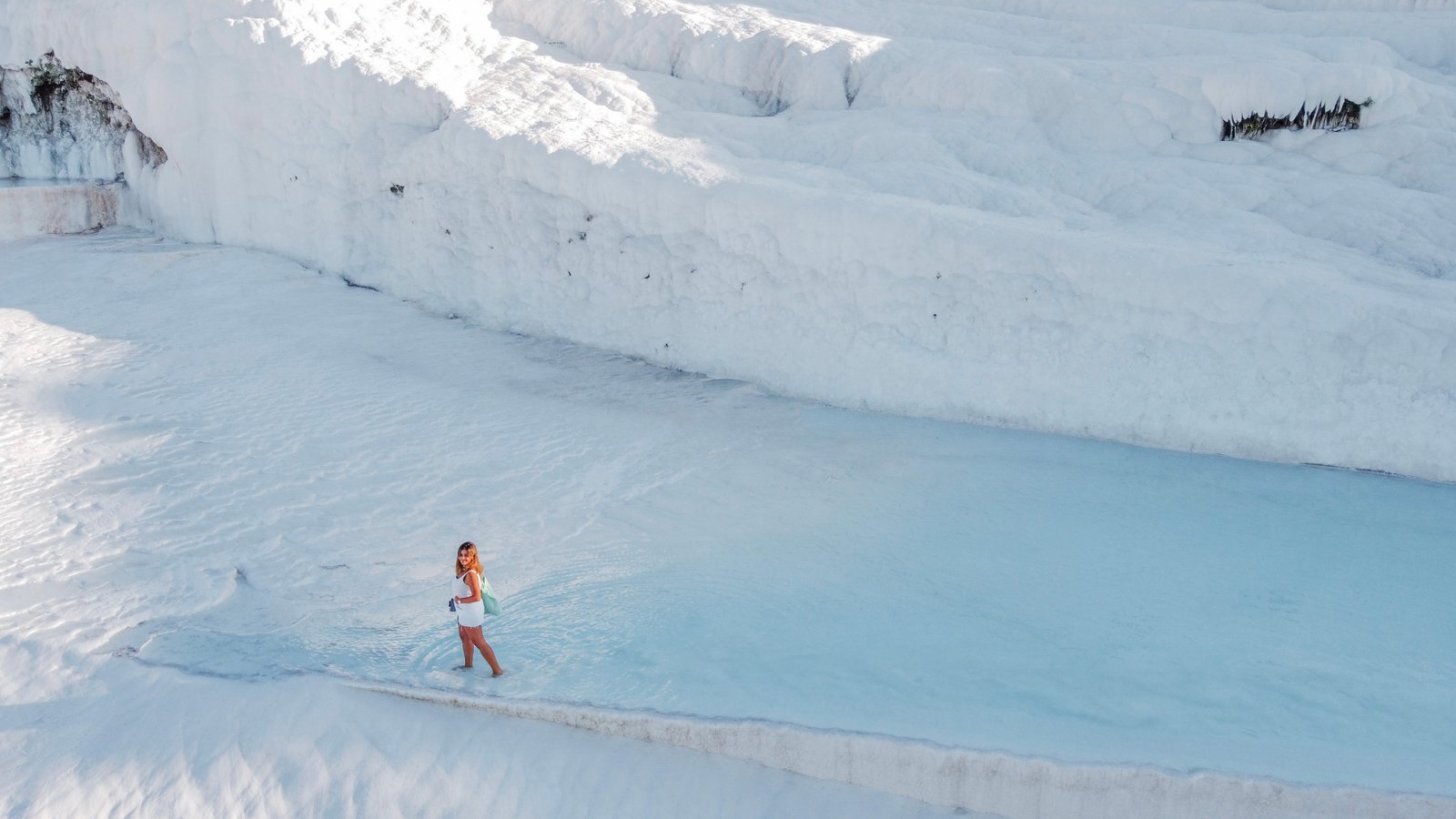
You probably ended up here after seeing an incredible photo on Pinterest or Instagram and wondering: does this cotton castle in Turkey actually exist? Welcome to the club!
I won’t deny it, Pamukkale is quite out of the way from the typical tourist routes. It requires careful logistics and a significant detour in your itinerary. If you’re still hesitating about whether it’s worth the effort, how much it will cost, or how to visit independently while escaping the massive tour buses, this is your sign to add it to your map.
In this ultimate travel guide, you’ll find ultra-specific insights based on my real experience, staying overnight in the village and exploring the site during hours when commercial tours aren’t even awake. Shall we?
⏱️ In a hurry? These are my favourite hotels:
What is Pamukkale and Why is it White?
Forget about snow or salt. Pamukkale (which translates to “cotton castle” in Turkish) is a natural complex of terraced pools formed by mineral-rich thermal waters, mainly calcium carbonate. Thousands of years ago, successive earthquakes opened fractures allowing this warm water to burst through. As it cascaded down the hillside and cooled, the mineral solidified, creating a unique white sedimentary rock called travertine.
The landscapes are incredibly similar to Terme di Saturnia in Italy and Hierve el Agua in Mexico.
Because the Romans deeply UNDERSTOOD the therapeutic power of these thermal springs, they founded Hierapolis right at the top—a ancient spa city whose vast ruins you can still explore today.
Unfortunately, decades of irresponsible tourism and hotels built directly over the site damaged the natural water flow. In 1988, UNESCO declared it a World Heritage Site. The hotels atop the travertines were demolished, footwear was strictly banned, and today the water flow is managed on a rotational schedule to preserve the pristine whiteness we all come to see.


How to get to Pamukkale, Turkey: details guide
1 Stop: Flight vs. Overnight Bus: What’s the Best Way to Reach Denizli?
Denizli is the mandatory transportation hub to reach the white terraces. The current best options depend on your travel style:
By plane (the fastest)
You can fly from Istanbul Airport (IST) or everywhere really, to Denizli Cardak Airport (DNZ) for an average of 30 EUR if booked in advance on Skyscanner.
The airport is located 65km away of the town of Pamukkale, so you have to follow the 2nd step.
By Overnight Bus (the backpacker friendly option):
To save a night of accommodation, take a direct long-distance bus from Istanbul Central Bus Station (Esenler Otogar) to the Denizli Otogar. The journey takes about 10 hours, and you can secure your seats for roughly 20 EUR using Busbud.
Final Step: How to Get to Pamukkale from Denizli
Once at the Denizli Otogar, head straight to the lower underground level and catch a local Dolmuş (minivan). It leaves every 15 minutes.
- Look for the minivan with the ‘Pamukkale’ sign and pay the driver directly in cash. It costs around 2 EUR (depending on the exchange rate), and they will drop you right in the center of Pamukkale village. From there, it’s just a short walk to almost any accommodation.
- Another alternative is Private Shuttle or Taxi: If you fly into the airport and prefer going straight to your hotel without transfers, a pre-booked shuttle will cost around 15 EUR to 20 EUR per person. A direct taxi from the airport costs around 25 EUR to 30 EUR. I highly recommend agreeing on the final price before getting in to avoid surprises.
Pamukkale Tickets, Current Prices (EUR) and Inside Tips
On local road signs, you will see the site indicated as Pamukkale Traverten. The general admission is a mandatory combined ticket that includes entry to both the white travertine pools and the archaeological ruins of Hierapolis.
Hierapolis and Cleopatra’s Pool: How Much Does it Actually Cost?
The basic entrance ticket costs 30 EUR, which you can purchase directly from the official government platform, or you can opt for a ticket including an audio guide, which is highly recommended for exploring Hierapolis.
🧚🏽 If you are planning an extended route through the country, check if the Museum Pass Turkey makes financial sense for you. It usually pays off quickly if you combine it with major sights in Istanbul and Cappadocia.
Cleopatra’s Antique Pool: If you want to swim among authentic submerged Roman columns, you need to purchase an additional ticket costing around 6 EUR. (You can walk in and look around for free; you only pay if you actually enter the water).
The 3 Access Gates: The Strategy to Avoid Crowds
The complex features three distinct entrances. Choosing the right one completely shapes your experience:
- South Gate (South Entrance): This is the ultimate choice if you want to beat the crowds. It opens at 6:30 AM. It is located at the top of the mountain, about a 45 to 50-minute walk from the village. I strongly advise taking a taxi to this gate early in the morning due to local wildlife along the rural paths.
- Town Gate (Center Entrance): This is a pedestrian-only access point that requires you to walk all the way up the travertine slope barefoot. It is incredibly convenient if your hotel is in the center, but because it opens later at 8:00 AM, you will inevitably encounter more visitors.
- North Gate (North Entrance): This is the primary gate used by commercial tour buses. It opens at 8:00 AM and places you near the ancient Necropolis of Hierapolis. Avoid this gate entirely first thing in the morning.
Beat the Crowds: Why You Need to Visit at Sunrise and Sunset
To be perfectly honest, by 11:00 AM, Pamukkale can transform from a serene natural wonder into an incredibly overcrowded walkway packed with thousands of day-trippers. My absolute recommendation is to split your visit into two epic moments: sunrise and sunset.
Sunrise and the Magic of Spontaneity on the Road
I woke up at 5:30 AM with a clear plan: stand at the South Gate by 6:30 AM to watch the sun rise over the empty terraces. Leaving my hotel in the village, I realized the town pedestrian gate was locked and walking to the South Gate would take nearly an hour uphill. Local taxi drivers tried to intimidate me, claiming wild wolves roamed the rural roads at dawn—mostly a sales pitch to secure a fare, but being alone in the pitch dark, I preferred not to risk it.
Luckily, the travel universe works beautifully. I found two other couples facing the exact same dilemma. We ended up squeezing into a rental car belonging to some travelers from Romania and Poland. So there we were—an Argentine, Poles, and Romanians, conquering the mountain together.
Entering the site at 6:45 AM was one of the most spectacular moments of my journey through Turkey. There were fewer than ten people in the entire complex. The water felt perfectly warm, hot air balloons began inflating along the horizon, and the reflection of the pastel pink sky on the pure white travertine left us completely speechless. If you love photography, this is your golden hour. No other time compares.
By 9:00 AM, just as the first mass tours were trickling in, I left the pools to explore the ruins of Hierapolis, escaping the intense heat. By 10:00 AM, my morning visit was complete.
The Sunset Trick
Technically, the ticket allows for a single, continuous entry. However, I was absolutely set on seeing the sunset from the top. When leaving at midday to grab lunch in the village, I used my best smile to ask the security guard if I could return later in the afternoon using the same ticket. He nodded yes. Even if you see signs stating otherwise, keep your physical ticket safe and try re-entering after 5:00 PM.
Sunset in Pamukkale was nothing short of epic. The water turned a vibrant, fiery orange. There were more people than at dawn, yes, but significantly fewer than at midday because the tour buses had already started their long drives back to their coastal resorts.

Where to Stay: the best hotels for every budget
Staying overnight in Pamukkale village is a brilliant move if you value slow, independent travel. The small town itself is highly tourist-dependent and can feel a bit dated, but it offers a massive logistical advantage: almost any hotel places you within a 10-minute walk from the main archaeological area.
💁🏽♀️ I chose to stay in Aspawa Hotel. It offers incredible value, a family-run atmosphere, and a fantastic location right in the village.
Pam Thermal Hotel Clinic & Spa: If you are looking for something premium, this resort features its own natural red-thermal mud pools. Note that it is located two villages over, closer to the North Gate rather than the center.
Naturalis Pamukkale Otel: Another brilliant option located in the heart of the village, featuring a lovely pool and easy pedestrian access to the site.
FAQ: Frequently Asked Questions About Traveling to Pamukkale
Is a Pamukkale Day Trip Worth it?
It entirely depends on your travel style. While commercial day trips offer convenience, you will arrive at peak hours, meaning you will share the pools with thousands of people, which takes away from the natural charm.
However, guided tours are highly valuable if you are a deep history enthusiast. You can easily find structured day tours departing from Antalya, Istanbul, Izmir, and Esmirna.
Why are Some Pools Dry or Empty in Pamukkale?
Yes, this is completely real. Due to water scarcity and to prevent the growth of algae that ruins the white color, the thermal water is systematically diverted through a series of controlled canals. This means you will find certain sections of terraces completely dry and closed to the public while others are beautifully full and flowing. This is not a scam; it is a vital environmental conservation effort. Rest assured, a major core section is always kept open for visitors to enjoy.
Are there hot air balloons in Pamukkale like in Cappadocia?
Yes, every single morning at dawn, dozens of hot air balloons take to the sky. While the scale is not as massive as in Cappadocia, seeing the white travertine terraces illuminated from above with balloons drifting around you is a magnificent alternative (and notably more affordable than flights in the Goreme region).
Is the detour in the Turkey itinerary actually worth it?
If you plan your logistics to experience it at sunrise or sunset, the answer is a resounding yes. Geologically, the landscape is mind blowing. It instantly reminded me of the frozen stone waterfalls of Hierve el Agua in Mexico, but on a monumental, historical scale. If you only visit for a couple of rushed hours in the middle of the day via a commercial tour, the experience degrades significantly.
What is the best time of year to visit Pamukkale?
Spring (April – June) & Autumn (September – October): The absolute ideal seasons. Temperatures hover comfortably around 25°C, the sun isn’t blindingly intense, and the warm thermal water is incredibly pleasant. Plus, daylight hours are long enough to explore Hierapolis without suffering from heat exhaustion.
Summer (July – August): The most challenging season—avoid it if you can. It marks peak tourism in Turkey, with temperatures soaring past 35°C and virtually no shade across the ruins, while day trip buses completely saturate the pools. If this is your only window, it is mandatory to use my strategy of entering at 6:30 AM.
Winter (November – March): The quiet, solo traveler route. It gets cold, around 5°C, and walking barefoot on the dry travertines will freeze your feet. However, you will have the Cotton Castle almost entirely to yourself, and bathing in the 36°C thermal waters against the crisp, cold air is an unforgettable contrast.
Because this specific corner of the country requires a considerable detour, the secret lies in how you fit it into your broader itinerary. My recommendation is to use Istanbul as your primary transport hub to either catch a quick domestic flight to Denizli or book an overnight sleeper bus.

If you are currently in the planning phase and haven’t decided how many days to allocate to the Turkish capital, you can dive into my complete Istanbul travel guide. And if you need more inspiration for your route, I continued my journey toward Bodrum on the Aegean coast before concluding the Turkish adventure in Cappadocia.
If you ever have any questions while planning, you can always drop me a direct message on Instagram.
Have an incredible journey to Turkey, and I hope to cross paths with you on the road soon!
For now, until next time.
Guadi.
